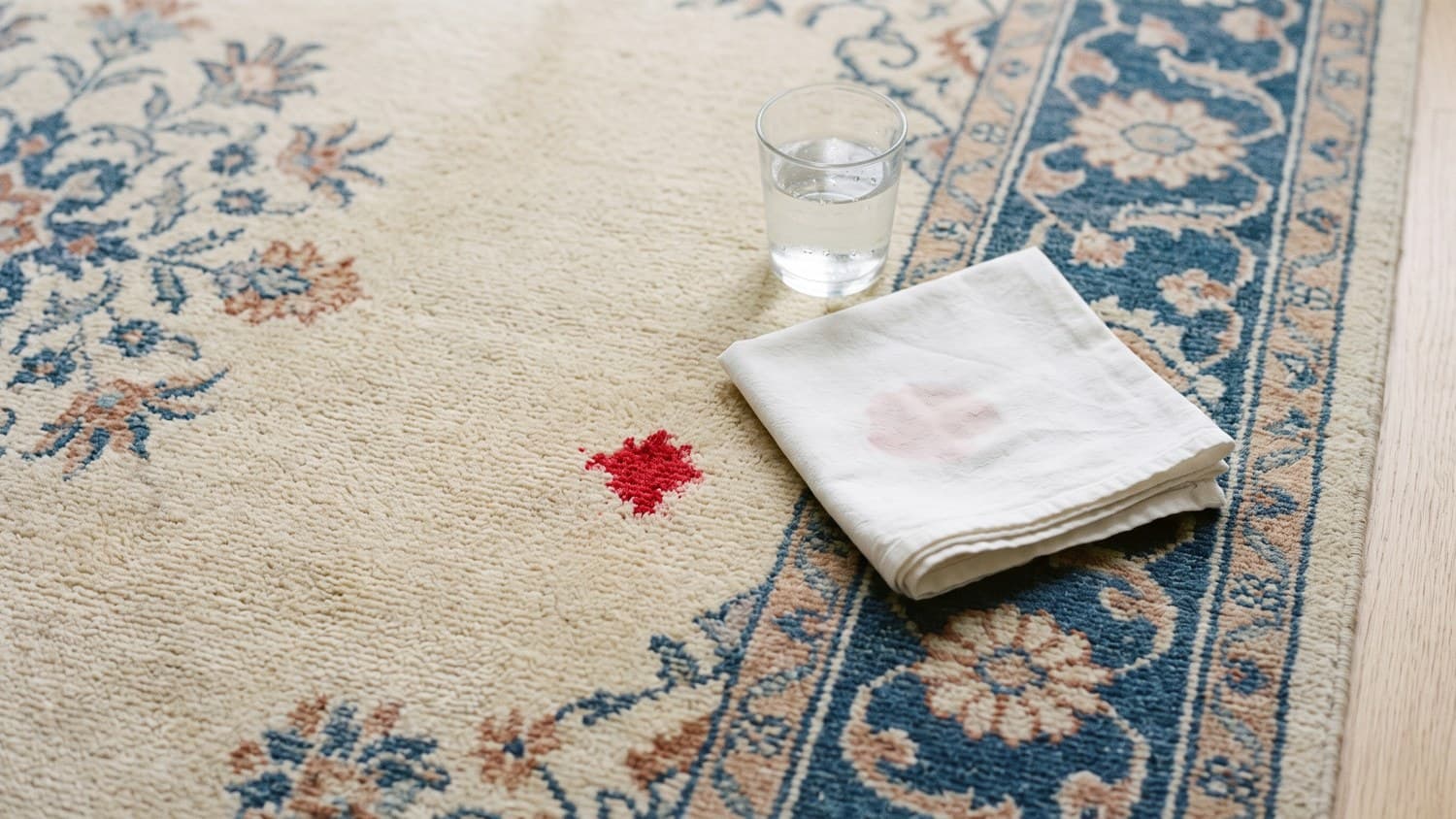
Why cold water, and why heat sets it.
Blood is a protein stain. Iowa State University Extension groups it with milk, mud, vomit and other protein stains, and its rule for all of them is the same: cold water, never hot water first, because heat can make the stain harder to remove or set it. UGA Extension puts it more briefly: stains set by heat will be difficult to remove.
The reason is in the blood itself. Hemoglobin is one of the two major proteins in blood, and a 2014 paper on how hemoglobin denatures states that temperatures around 50°C (122°F) lead to rapid, irreversible denaturation, followed by precipitation. Once that has happened, the protein does not go back.
Wool is protein too. Wool keratin is a fibrous protein, and keratin is a main structural part of both wool and hair. That shared chemistry is why some of the products sold for blood need care on a wool rug.
The first response, step by step.
- Act quickly. The Carpet and Rug Institute warns that delaying may cause a spill to become a permanent stain.
- Blot with a dry, white cloth. Press and lift; do not rub. The Canadian Conservation Institute advises dabbing gently, because rubbing only pushes the stain into the rug more.
- Work from the edges toward the center, which the Carpet and Rug Institute recommends to keep the spill from spreading.
- Test first. Try your cleaning solution on a hidden corner and look at the cloth for the rug’s own color. If color comes off, stop and choose another approach: that is dye moving, the problem described in our color bleed guide.
- Blot with cool, mild detergent. For blood on a wool rug, UGA Extension mixes 1 teaspoon of a mild, non-alkali detergent with half a pint of cool water, adds a small amount to the stain and blots, taking care not to force the stain further into the fiber, and keeps blotting until no more comes out.
- Be patient. Keep going for as long as the stain is still transferring to the cloth. Complete removal may take several repeats.
- Rinse and dry without heat. Rinse with cold water and blot with a dry cloth until the moisture is gone. Use as little water as you can: the Carpet and Rug Institute recommends a mist sprayer to prevent overwetting. Skip the hair dryer. Heat is what sets blood, and the Canadian Conservation Institute notes that heat causes wool to lose its natural oils, which weakens the threads.

When the blood has dried.
Old blood changes color. Forensic researchers describe bloodstains moving from bright red to dark brown as the hemoglobin in them oxidizes into met-hemoglobin and hemichrome. So a brown mark on the rug is still blood, in an oxidized form.
Start with any dry crust. The Carpet and Rug Institute’s first step is to scrape up semi-solids gently with a rounded spoon, and to break up solids and vacuum. Then go back to the cool detergent blotting above and repeat it for as long as the cloth still picks up color.
An old stain may not come out completely at home. The Carpet and Rug Institute warns that delaying may cause a spill to become a permanent stain, and notes that professional cleaners can use more aggressive cleaning solutions on stubborn spills.
Peroxide, ammonia and enzyme cleaners.
Hydrogen peroxide. UGA Extension lists it as a late step for washable fabric, but not in its steps for wool rugs. Peroxide is also used to bleach wool: a patent on wool treatment describes peroxide treatments “for the purpose of bleaching wool.” A bleached spot is the work of color restoration.
Ammonia. The Carpet and Rug Institute lists an ammonia solution for blood on carpet, with a warning that it can cause a color change. UGA Extension is plainer: ammonia damages silk and wool, and if it must be used on those fibers, it should be diluted with an equal amount of water and used sparingly.
Enzyme cleaners. UGA Extension’s fabric steps for blood use an enzyme pre-soak; its steps for wool rugs do not. Proteases are one of the key enzymes in enzyme detergents, and researchers at Aston University warn that proteases can cause irreversible damage to natural protein fibers such as wool or silk, including loss of strength and shape and poor color fastness.
When to call.
Call when the stain is old or large, when the rug’s color moved during your test, or when heat or peroxide has already been tried. The Carpet and Rug Institute’s own advice is to always consider consulting a professional cleaner on any spot removal question. Tell us what happened, when, and whether anything warm has touched it. The quote is free, and it comes before any work. Between accidents, our wool rug guide covers routine care, and our rug cleaning service covers the rest.
SourcesShow 10Hide
- Holiday Stains. Iowa State University Extension and Outreach, AnswerLine (2022).
- Remove Stains From Blood. University of Georgia Cooperative Extension, Textiles.
- Spot Solver: Blood. The Carpet and Rug Institute.
- Basic care - Carpets and rugs. Canadian Conservation Institute, Government of Canada.
- Denaturation of Hemoglobin in the Presence of Tannic Acid. Grigoryan and Sargsyan, Proceedings of the Yerevan State University, Chemistry and Biology (2014).
- Biphasic Oxidation of Oxy-Hemoglobin in Bloodstains. PLoS ONE (2011), via PubMed Central.
- Keratin protein nanofibers from merino wool yarn. RSC Advances (2024), via PubMed Central.
- The Complexity of the Ovine and Caprine Keratin-Associated Protein Genes. International Journal of Molecular Sciences (2021), via PubMed Central.
- Transglutaminase treatment of wool fabrics leads to resistance to detergent damage. Aston University research portal.
- US5697983A, Method for the treatment of wool. Google Patents.