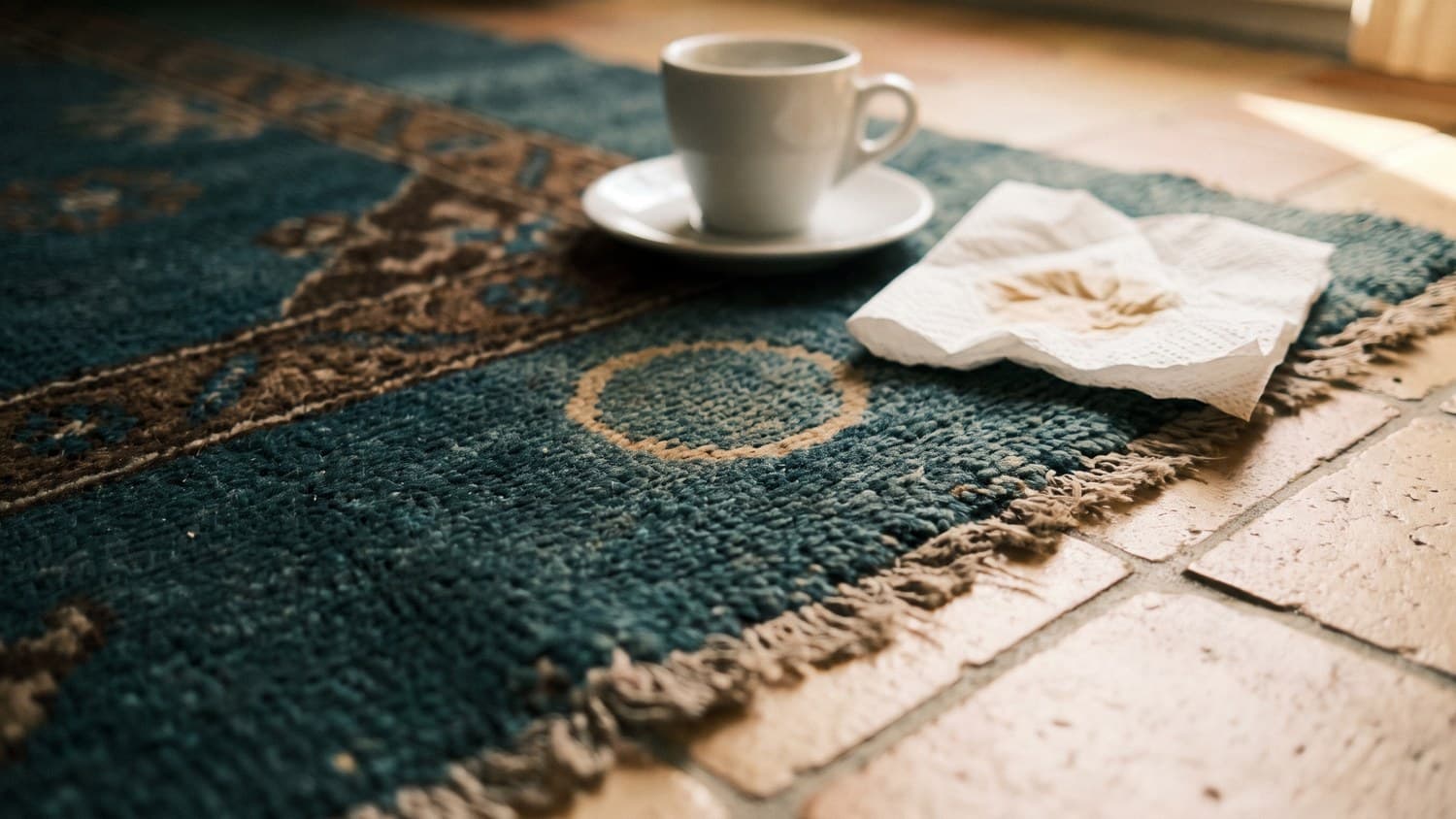
Black coffee and coffee with milk are different stains.
Coffee looks like one stain. An Iowa State extension stain guide puts coffee among the tannin stains, with tea, berries and fruit juice, and milk among the protein stains, with blood and baby formula. Coffee with milk or cream is both at once.
The guides written for carpets and rugs keep the distinction. The Carpet and Rug Institute has one page for coffee and another for coffee with cream and sugar, and only the second starts with a solvent. The University of Georgia’s carpet entries for wool split the same way. Bremworth, a wool carpet maker, treats coffee with water and then diluted vinegar, but milk and cream with water and then a dry stain remover.
It matters for a practical reason: the two halves want different handling. Natural soap makes tannin stains harder to remove, and hot water sets protein. Red wine is a tannin stain too, and it has its own guide: how to remove red wine from an oriental rug.
How to get coffee out of a rug immediately.
Act now. The carpet industry’s guidance for coffee opens with a warning that delay can turn a spill into a permanent stain, and an extension guide draws the line at a day: fresh stains are much easier to remove than those over 24 hours old.
Blot with a dry white cloth or white paper towels, pressing straight down. Do not rub. Rubbing spreads the stain and can take color out of the fiber, and on wool it drives the liquid deep into the pile and into the backing, where it is much harder to remove. Wool gives you some help here: a wool carpet maker describes it as naturally stain and soil resistant.
If the cup had milk, cream or sugar, or you are not sure, use cool water for the first rinse. Hot water sets protein stains, and cold water is the safe start for any stain you cannot name.

The method for black coffee.
On an antique or valuable rug, stop after blotting and call us. On other wool rugs, the University of Georgia Extension’s method for coffee on wool carpet runs in four moves. Before the first one, test whatever you mix on a hidden corner and check that no color moves onto the cloth.
Detergent. Mix a teaspoon of a neutral detergent, meaning a mild one with no alkalies or bleaches, into a cup of lukewarm water. Work small amounts into the pile with your fingers, blot, flush with water, and blot again. The Carpet and Rug Institute uses a weaker mix, a quarter teaspoon of liquid dish detergent per cup, and warns never to go stronger.
Vinegar. Blot the stain with a cloth dampened in one-third cup of white vinegar mixed into two-thirds cup of water. Then sponge with clear water and blot.
Draw it out. Lay a half-inch layer of dry paper towels or cloths over the spot and weight it with a book. Replace the towels whenever they turn wet, and leave it for several hours.
Lift the pile. Brush the area by hand to stand the pile back up. Give each step time to work, since some stains need more than one round. If color starts to move at any point, stop and read how to remove color bleed from a rug.
Coffee with milk, cream or sugar.
Start cool. Milk is a protein stain, and hot water first can set it. Blot, rinse with cool water, and blot again.
Then deal with the cream. The Carpet and Rug Institute’s first agent for coffee with cream and sugar is a solvent: a non-flammable spot remover or a dry-cleaning type solvent. Put it on a cloth, never pour it onto the rug, and keep it away from the backing. The University of Georgia’s wool entry for coffee with cream also begins differently, by gently scraping away the excess, before the same detergent and vinegar steps as black coffee.
Sugar does not change the method: both the carpet industry and the extension guide fold it in with cream. What does matter is the rinse at the end. Residues left in the pile attract soil, which is why the industry method finishes with cool water and blotting until no moisture is left.
Vinegar, dish soap and peroxide: what each one does.
Vinegar is a real step, but a second one. Two wool sources, the University of Georgia and Bremworth, both use one part white vinegar to two parts water after water or detergent. The Carpet and Rug Institute says what the vinegar is mostly for: lowering the alkalinity a detergent leaves behind. It finishes the detergent step rather than replacing it.
Dish soapis the detergent in the carpet industry’s method. The Carpet and Rug Institute specifies a quarter teaspoon of liquid dish detergent per cup of lukewarm water and says never to use a stronger concentration, because detergent left behind causes rapid soiling. Three kinds to avoid: laundry detergent, which can carry optical brighteners that dye the fiber; dishwasher detergent, since many contain bleaching agents; and natural bar or flake soap, which makes tannin stains harder to remove.
Hydrogen peroxide and bleach remove color, which is what makes them tempting. A New Mexico State extension guide files hydrogen peroxide under bleach, described as removing unwanted color, and a Kentucky extension guide notes that yellow marks on carpet point to strong oxidizers or bleaches. On a rug, the dye is color too.
Heat of any kind. Heat sets stains, and heat of any kind is hard on wool: the Canadian Conservation Institute notes that it costs wool its natural oils, which weakens the threads. No hot water, no steam, and no hair dryer on the damp spot.
Dried and old coffee stains.
Dried coffee is harder to move. The University of Georgia notes that tannin stains are difficult to treat, and fresh stains come out much more easily than ones over a day old. The method is still the same: work the detergent solution in and blot, follow with the vinegar mix, and use the weighted towels to draw the stain up over several hours. Expect more than one round. A University of Kentucky Extension guide notes that when a spot has an odor, a foreign substance is present. So if a smell outlasts drying, the rug needs washing through rather than another spot treatment.
Stop and call when the coffee is on silk or an antique, when a household attempt has already used bleach, peroxide or heat, when color has started to move, or when the mark keeps returning after the rug dries. The Canadian Conservation Institute’s advice for important rugs is to skip commercial carpet shampoos and consult a professional, and professional cleaners have stronger solutions and the equipment to use them.
A rug, unlike wall-to-wall carpet, can come off the floor for a full cleaning.
Sources
- Remove Stains From Coffee, Tea (Carpet: wool). University of Georgia Cooperative Extension. https://site.extension.uga.edu/textiles/care/stain-removal/remove-stains-from-coffee-tea/
- Holiday Stains (AnswerLine). Iowa State University Extension and Outreach. https://blogs.extension.iastate.edu/answerline/2022/12/13/holiday-stains
- Spot Solver: Coffee. The Carpet and Rug Institute. https://carpet-rug.org/spot-solver/coffee/
- Spot Solver: Coffee with Cream & Sugar. The Carpet and Rug Institute. https://carpet-rug.org/spot-solver/coffee-with-cream-sugar/
- Stain Guide (based on advice from Wools of New Zealand). Bremworth. https://bremworth.com.au/pages/stain-guide
- Removing Clothing Stains (Guide C-502). New Mexico State University Cooperative Extension. https://pubs.nmsu.edu/_c/C502.pdf
- Cause and Prevention of Carpet and Upholstery Spots and Stains (HF-LRA.074). University of Kentucky Cooperative Extension. https://fcs.mgcafe.uky.edu/sites/fcs.mgcafe.uky.edu/files/hf-lra.074.pdf
- Basic care: Carpets and rugs. Canadian Conservation Institute. https://www.canada.ca/en/conservation-institute/services/care-objects/textiles-costumes/basic-care-carpets-rugs.html