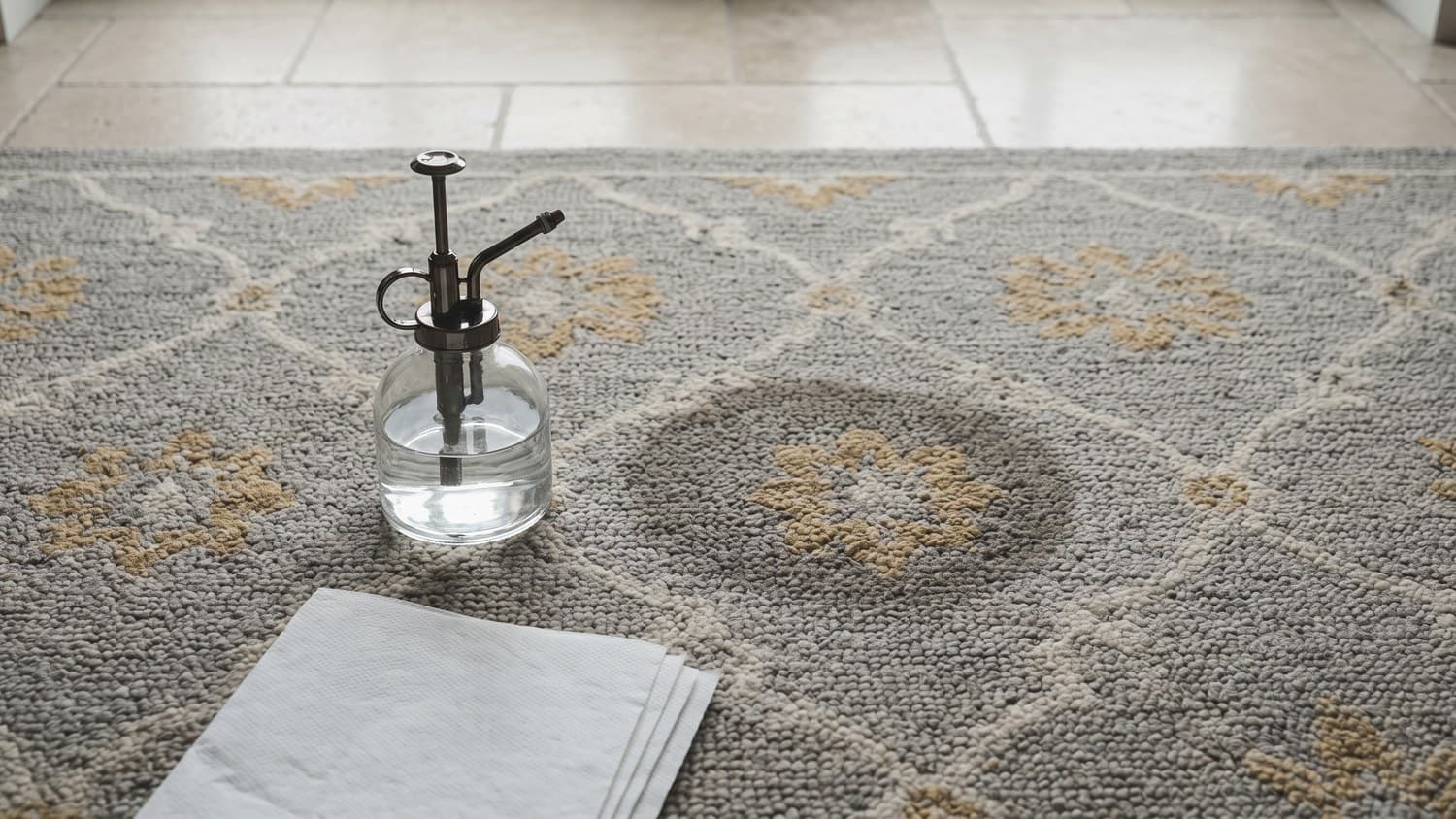
What vomit leaves in a rug.
You see one stain. There are three things in it, and each answers to a different rule. The first is acid. Vomit carries hydrochloric acid, and a University of Kentucky Extension table of chemicals that discolor carpet lists vomit beside toilet-bowl cleaner as a source of it, along with the mark it can leave on textiles: pink or orange, or bright blue on fibers dyed red.
The second is protein. An Iowa State extension stain guide classes vomit with blood, milk and baby formula as a protein stain, and the rule for protein is cold water, because hot water first can set it. The third is color from bile. Small amounts of bile are normal in vomit, and a hard stomach bug can bring up little else. Vomit that is yellow or green often means bile, and bile carries bilirubin, a yellowish pigment.
Urine is a different accident with its own chemistry, and it has its own guide: how to remove pet urine from an oriental rug. If the person or pet who was sick needs looking after, see to them first. The rug can wait.
The first few minutes.
Put on rubber or disposable gloves, the first step in the CDC’s cleanup advice for a stomach bug. Then lift what is solid. Scrape semi-solids up gently with a rounded spoon, moving from the edge toward the center so the mark shrinks rather than spreads. If the solids have already dried, break them up and vacuum them away.
Blot the liquid with a dry white cloth or white paper towels, pressing straight down. Do not rub. Rubbing pushes the stain further into the rug, can take color out of the fiber, and on wool can drive liquid down through the pile into the backing, where it is much harder to reach.
Then a little cool water. A wool carpet maker’s routine for pet accidents, vomit included, is short, and the same steps apply to dog or cat vomit: pour a small amount of water on the spot, press with dry paper towels, discard them, and repeat until nothing more comes up. Use only enough water to work with. A mist sprayer helps, and the rug should never be soaked. Finish by blotting until no more moisture comes away.

If water alone does not lift it.
On an antique or valuable rug, stop after blotting and call us. On other wool rugs, go one step at a time, and test each solution on a hidden corner before it touches the stain. Bremworth, a wool carpet maker working from Wools of New Zealand advice, lists three treatments for vomit, in this order: room-temperature water, then a clear household disinfectant, then one-third cup of white vinegar in two-thirds cup of water. The Carpet and Rug Institute’s sequence for vomit opens with a weak detergent solution: a quarter teaspoon of liquid dish detergent in a cup of lukewarm water, and never stronger.
Whatever you use, the method stays the same. Test it first on a hidden corner and check the cloth for color. Put a little on a white cloth rather than on the rug, work it in gently from the edge toward the center, leave it a few minutes, and blot. Keep going with the same solution while the stain is still transferring to the cloth. Then rinse with cool water and blot again, because detergent left in the pile can cause rapid soiling.
Two cautions on the products. Use liquid dish detergent only: laundry detergents can carry optical brighteners that dye the fiber, and dishwasher detergents can carry bleaching agents that destroy dyes. And test the disinfectant with particular care, since the Kentucky list of chemicals that discolor carpet includes disinfectants, with fading of color as the result.
What makes it worse.
Hot water and steam. Vomit is a protein stain, and hot water first can set protein. Heat of any kind is hard on wool: the Canadian Conservation Institute notes that it costs wool its natural oils, which weakens the threads.
Baking soda.It is the usual suggestion for the smell, but neither the Carpet and Rug Institute’s vomit sequence nor Bremworth’s lists it, and spot-removal residues left in a carpet may attract soil. Whatever goes into the pile has to come out again.
Enzyme pet sprays.They work on vomit because they carry protease, the enzyme that breaks down protein. The trouble is that proteases attack wool as well: a review of enzyme treatments used in wool processing found that proteases get inside the fiber and cause weight and strength loss. One enzyme cleaner’s own product description says not to use it on wool specialty fabrics.
Bleach and ammonia. Household bleaches are on the Kentucky list of chemicals that change carpet dyes, leaving yellow marks, or green on fibers dyed red. Ammonia, which appears on the carpet industry’s list for vomit, comes with its own warning that it can cause a color change. If someone in the house has norovirus, follow the CDC’s cleanup guidance for the home, and call us before any bleach goes on a rug. For what happens once a rug’s own dye starts to move, see how to remove color bleed from a rug.
Why the smell stays, and how to end it.
A smell is information. The Kentucky Extension guide puts it plainly: if a spot has an odor, a foreign substance is present. With vomit, the smell is the residue that has not come out yet, in the pile or below it.
So the answer to the smell is the answer to the stain: remove what is there rather than cover it. Blot, rinse with cool water, blot dry, and repeat while anything still transfers to the cloth. Several light rinses are often needed, and misting rather than pouring keeps the rug from being overwetted.
If a smell is still there once the rug is fully dry, something is still in it, and a spot treatment has reached its limit. That is the point to have the rug washed through rather than keep treating the top. Our longer note on why rug odors come back covers smells of every kind.
Old stains, color changes and when to call.
Time works against you. Stains over a day old are much harder to remove than fresh ones, and the carpet industry warns that delay can turn a spill into a permanent stain. With a dried stain, start the same way: break up and vacuum the solids, then work through the water-first sequence above.
What cleaning cannot undo is a color change. Chemical stains can surface days after the event, and once a chemical has changed or destroyed a dye, the Kentucky guide is frank that nothing can usually restore it to its original color. A pink, orange or pale patch that stays after the residue is gone is that kind of mark, and it is a question for color restoration rather than more cleaning.
Call when the spot is on silk, on an antique, or on a rug whose dyes have bled before; when bleach, ammonia, an enzyme spray or heat has already been tried; when the smell outlasts drying; and when the color has shifted. Professional cleaners have stronger solutions and the equipment to use them, and the Canadian Conservation Institute’s advice for important rugs is to consult a professional rather than reach for carpet shampoo. A rug, unlike wall-to-wall carpet, can come off the floor for a full cleaning.
Sources
- Cause and Prevention of Carpet and Upholstery Spots and Stains (HF-LRA.074). University of Kentucky Cooperative Extension. https://fcs.mgcafe.uky.edu/sites/fcs.mgcafe.uky.edu/files/hf-lra.074.pdf
- Holiday Stains (AnswerLine). Iowa State University Extension and Outreach. https://blogs.extension.iastate.edu/answerline/2022/12/13/holiday-stains
- Spot Solver: Vomit. The Carpet and Rug Institute. https://carpet-rug.org/spot-solver/vomit/
- Stain Guide (based on advice from Wools of New Zealand). Bremworth. https://bremworth.com.au/pages/stain-guide
- Basic care: Carpets and rugs. Canadian Conservation Institute. https://www.canada.ca/en/conservation-institute/services/care-objects/textiles-costumes/basic-care-carpets-rugs.html
- Preventing Norovirus. US Centers for Disease Control and Prevention. https://www.cdc.gov/norovirus/prevention/index.html
- Throwing Up Bile. Cleveland Clinic. https://my.clevelandclinic.org/health/symptoms/throwing-up-bile
- Bilirubin blood test. MedlinePlus, US National Library of Medicine. https://medlineplus.gov/ency/article/003479.htm
- Enzymatic treatment of wool: A review (Mojsov, Janevski, Andronikov, 2014). Tekstilna industrija 61(4). https://eprints.ugd.edu.mk/12967/
- Advanced Stain & Odor Eliminator for Dogs, product description. Nature's Miracle. https://www.petsmart.com/dog/cleaning-supplies/stain-and-odor-removers/natures-miracle-advanced-stain-and-odor-eliminator-for-dogs-enzymatic-formula-5268787.html
- No More Stains + Odours, product description. Yours Droolly. https://peto.com.au/yours-droolly-no-more-stain-odour-for-pets/