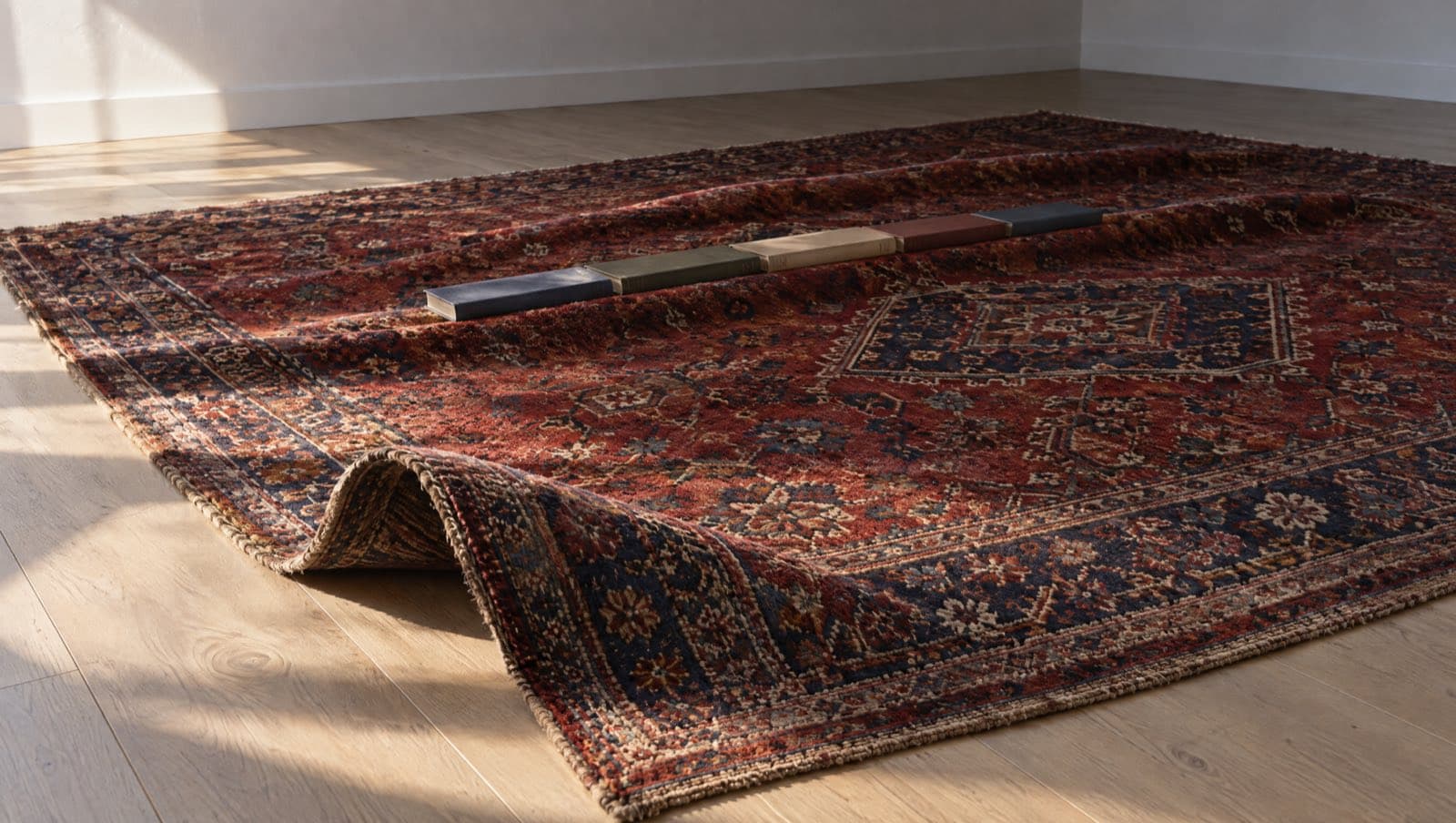
Why a rug creases and curls.
A hand-knotted rug is a woven structure. Its foundation is two sets of threads, warps running its length and wefts across, and the pile is knots tied around pairs of warps. The warps and wefts can be wool, cotton or linen. Much of what the rug does with shape comes from that foundation rather than from the pile you can see. Rolled for months, the foundation holds the curve it was held in for a while after it is laid flat. Folded, it does something worse: the Canadian Conservation Institute warns that creases may leave permanent marks or cause threads to break, which is why a rug is stored rolled rather than folded.
Curling has other causes. Textiles take moisture from the air, and the Institute of Conservation notes that a dry atmosphere makes fibers shrink and a damp one makes them swell. The IICRC adds that the edges of some woven rugs curl or wave because of variations in how they were built, and that this typically shows after cleaning or in high humidity. A wavy edge can also come from a damaged edge, and that belongs with edge repair rather than with flattening. Hand-tufted rugs are a separate case: a latex adhesive holds them together, and the IICRC says that glue usually starts to dry out and break down after five to ten years.
Flattening a crease, properly.
Begin by doing nothing. Lay the rug out flat, face up, in a room at normal living temperature, and give it several days. The IICRC’s consumer tip sheet says curled edges often correct themselves within a few days, and every method below works better on a rug that has had that time.
If a ridge persists, reverse-roll it. Roll the rug the opposite way, face down so the pile is on the outside of the roll and the crease bends against its habit, and leave it for a few days before laying it flat again. The IICRC describes this fix for curled edges, and warns that tying a rug too tight can damage the backing, crush the fiber and distort the rug, so keep the roll loose. If the rug is old, stiff, or crackles as it bends, do not reverse-roll it; weight it flat and wait instead. The textile conservators of the AIC note that incorrect rolling may cause deep wrinkles, splits and distortion. On a sound rug, reverse-rolling is a simple, safe first step.
Weight comes third, and how it is applied matters more than how much of it there is. Spread the load: flat boards, a run of books laid along the length of the ridge, or furniture with broad feet on a protective board. Never a single heavy object on one point, which can crush the pile where it sits; the Canadian Conservation Institute recommends castor cups under furniture feet to help spread the weight. If what you use could mark the rug, put a barrier between them, as the IICRC suggests with a plastic bag against rust or dye. Give it days rather than hours, and check progress in low raking light across the rug, which shows a ridge that overhead light hides.

Curled corners and the pad.
Rug corners curling up are worth taking seriously for two reasons beyond how they look. A curled corner is a trip hazard in a hall or doorway, and it is wearing itself: the Institute of Conservation notes that edges and fringes are particularly vulnerable to wear and that folds create weak areas which will eventually wear. A corner that curls and is stepped flat again for years can wear through along that line.
The fix is usually the same, and it is not clever. Fit the rug with a pad. The Institute of Conservation says a rug pad cushions the rug and allows it to lie flat and evenly. The Canadian Conservation Institute’s guidance is an underlay 1/8 to 1/4 inch (3 to 6 mm) thick, large enough to reach the edge of the rug, and both bodies advise against underlays with adhesive; the CCI also lists foam rubber, vinyl, jute and recycled felt among the underlays to avoid. Check the pad and the rug now and then, and replace a pad that is breaking down.
For a corner that has learned its habit, reverse-roll just that corner for a day before laying it down on the pad. If the rug is old, stiff, or crackles as it bends, do not reverse-roll it; weight it flat and wait instead. Avoid adhesive tape on the back of the rug: the Institute of Conservation advises owners against adhesives or adhesive tape, even for temporary repairs.
What not to do.
An iron, first of all. The IICRC’s tip sheet rules irons out because they are too hot and can quickly melt synthetic fibers, and pressing guidance from New Mexico State University says an iron should not be placed directly on wool. A steamer and a hair dryer are the other popular answers. The same IICRC tip sheet does suggest a clothes steamer to relax a curled edge, with weight on top for 24 hours. On a hand-knotted wool rug we would leave both out: the Canadian Conservation Institute notes that heat causes wool to lose its natural oils, which weakens the threads, and that high humidity may cause colors to bleed. Time, a loose reverse-roll and spread weight carry less risk.
Wetting the rug to relax it is the other tempting error. Damp that goes in dries unevenly, and the AIC’s textile conservators note that changes in humidity can change the dimension and shape of a textile, so a modest crease can become a fresh distortion. On a rug whose dyes are not colorfast it also invites color bleed. Controlled damp is what blocking uses, which is why blocking is bench work. And do not force a stiff old rug backward against its curve in one movement, which risks the splits the AIC warns about.
When it is a repair.
Three signals, and any one of them ends the do-it-yourself phase. Ripples that flatten under weight and come back within days. An edge that has gone wavy rather than straight. And a rug that no longer sits square, where one corner reaches further than the one opposite it. Each suggests the foundation has been pulled out of its original shape, by a long fold, by uneven drying after a wash, or by years of use, and weight alone is unlikely to correct it.
What can correct it is blocking. Textile conservators humidify textiles under control to reduce creasing, wrinkling and planar distortion, and the AIC’s textile group describes padded tables used for blocking. On a rug, blocking means drawing it back to its true dimensions and letting it dry flat in that position. Where the distortion has a cause, such as a broken edge or a slack area of foundation, the cause needs repair at the same time, or the rug can drift back out of shape. That is the territory of rug repair, and where the structure has moved more broadly, of restoration.
Keeping it flat afterward.
Four habits, none of them demanding. Keep the pad under it. Rotate the rug once or twice a year, which the IICRC recommends to prevent uneven wear and fading, and which is also covered in our wool rug guide. Roll rather than fold, with the pile facing out and in the direction of the pile, around a wide tube, loosely enough to slide a hand inside. The Canadian Conservation Institute’s storage note says to roll pile carpets right side down so the pile is on the outside, in the direction of the pile so it is not crushed, and the Institute of Conservation and the AIC give the same direction. And if the rug has been washed, make sure it dried flat.
Beyond that, give a new crease its week before deciding anything. A ridge that flattens under weight and keeps coming back is the sign that the rug needs the bench. If what yours needs is a pad and some patience, that is what we will tell you.
Sources
- Rolled Storage for Textiles (CCI Notes 13/3). Canadian Conservation Institute (CCI), Government of Canada. https://www.canada.ca/en/conservation-institute/services/conservation-preservation-publications/canadian-conservation-institute-notes/rolled-storage-textiles.html
- Basic care: Carpets and rugs. Canadian Conservation Institute (CCI), Government of Canada. https://www.canada.ca/en/conservation-institute/services/care-objects/textiles-costumes/basic-care-carpets-rugs.html
- Carpets and rugs (Caring for your treasures). Icon, The Institute of Conservation. https://icon.org.uk/conservation-hub/caring-for-your-treasures/carpets-and-rugs.html
- Consumer Floor and Furnishings Care Information: area rugs (tip sheet). IICRC. https://iicrc.org/wp-content/uploads/2023/01/Tip-Sheet-Onsite-Area-Rugs.pdf
- TSG Chapter VIII, Storage of Textiles, Section D: Storage Methods. American Institute for Conservation, Textile Specialty Group (conservation wiki). https://conservation-wiki.com/wiki/TSG_Chapter_VIII._Storage_of_Textiles:_Issues_and_Methods_Textile_Conservators_Face_when_Planning_for_Textile_Storage_-_Section_D._Storage_Methods
- TSG Chapter III, Environmental Concerns for Textiles, Section A: Temperature and Relative Humidity. American Institute for Conservation, Textile Specialty Group (conservation wiki). https://www.conservation-wiki.com/wiki/TSG_Chapter_III._Environmental_Concerns_for_Textiles_-_Section_A._Temperature_%26_Relative_Humidity_(RH)
- Humidification (TSG). American Institute for Conservation, Textile Specialty Group (conservation wiki). https://conservation-wiki.com/wiki/Humidification_(TSG)
- Carpet, museum number O78728. Victoria and Albert Museum. https://collections.vam.ac.uk/item/O78728/carpet-unknown/
- Caring for your collections: textile conservation tips. Winterthur Museum, Garden and Library. https://www.winterthur.org/caring-for-your-collections-textile-conservation-tips/
- Pressing Pointers (Guide C-309). New Mexico State University Cooperative Extension Service. https://pubs.nmsu.edu/_c/C309/index.html