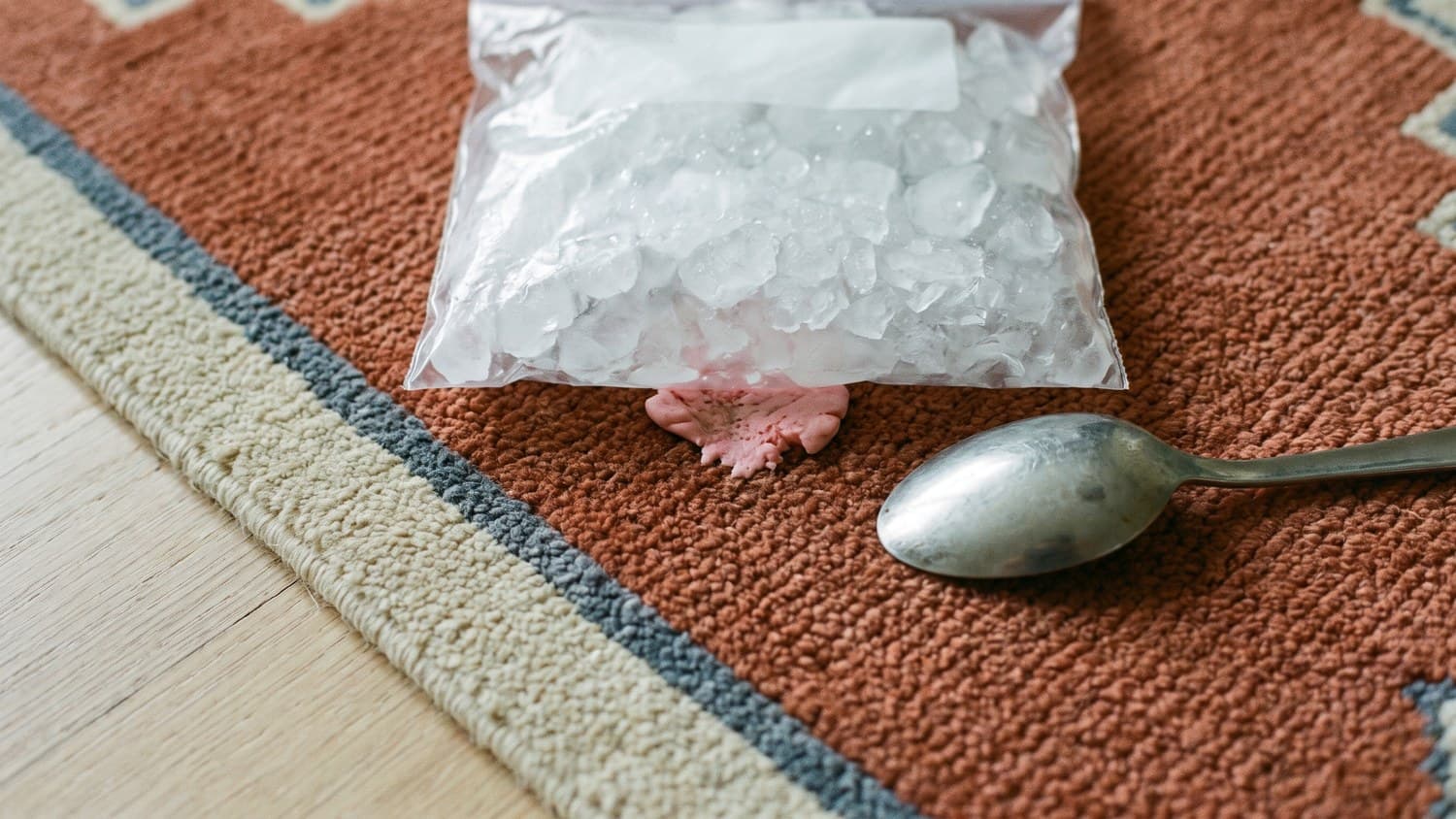
Why cold works, and heat does not.
Chewing gum is built on a rubbery base. In the words of a Wrigley patent on gum base, “elastomers provide the rubbery cohesive nature of the chewing gum.” The same patent describes what it calls cold flow: when the temperature rises above the gum base’s glass transition temperature, the base changes shape and flows.
So warm gum moves, and cold gum does not. UGA Extension’s carpet method starts with ice: an ice cube in a plastic bag, left on the gum until it is “hard or frozen,” and then the gum and residue are carefully scraped away.
The method, step by step.
- Shield the rug. UGA Extension cuts a hole the size of the gum in a piece of cardboard and lays it over the spot, so the cold does not freeze the rest of the rug and frozen pieces of gum do not scatter.
- Chill it. Put ice in a closed plastic bag and rest it on the gum until the gum is hard or frozen. UGA Extension gives no time limit; the test is the gum, not the clock.
- Scrape, gently. Use a rounded spoon, as the Carpet and Rug Institute does, and lift the pieces off rather than pulling.
- Vacuum the pieces. The Carpet and Rug Institute’s first step for gum ends with “break up solids and vacuum.” On a rug, the Canadian Conservation Institute advises a standard vacuum head, not a power head, and a low level of suction.
- Repeat. If the lower part is still soft, chill it again and scrape again. Complete removal may take several repeats.
- Treat the film. UGA Extension cleans any remaining gum with a dry-cleaning solvent on a clean white pad, without getting the backing wet. The Carpet and Rug Institute names a non-flammable spot remover or dry-cleaning type solvent, applied to a white cloth and worked in gently from the edges toward the center to prevent spreading, and warns never to pour it directly onto the carpet. Work with ventilation, rubber gloves and no open flame nearby, as UGA Extension advises.
- Test first, and rinse after. Try the solvent on a hidden corner. If the rug’s color comes onto the pad, stop: that is dye moving, the problem in our color bleed guide. Spot removers can leave residues that attract soil, so the Carpet and Rug Institute rinses the area several times with lukewarm water and blots it dry after each rinse.

What not to do.
Do not warm it. A hair dryer or hot water works against you: the Wrigley patent notes that gum base kept above its glass transition temperature can deform. Heat is also hard on the rug. The Canadian Conservation Institute notes that heat causes wool to lose its natural oils, which weakens the threads.
Do not pull it while it is soft. Soft gum is rubbery. Chilling it first is what lets it come away hard, in pieces.
Do not use peanut butter or cooking oil. They are not part of the published carpet methods, and the Carpet and Rug Institute warns that residues left in carpet may attract soil; it also has a separate spot-removal method for oil. The only oil in UGA Extension’s carpet steps is measured: if a stain remains after the solvent, it mixes 1 part coconut oil or mineral oil with 8 parts liquid dry-cleaning solvent as a Dry Spotter.
Do not cut the pile. In a hand-knotted rug, the pile is made of knots: as the Victoria and Albert Museum describes one, each knot of colored thread is tied around two adjacent warp threads as the foundation is woven. Cutting the gum out takes that wool with it. A cut pile is a job for rug repair, not cleaning.
When to call.
Call when the gum has been there a long time, when the rug is silk or antique, when oil or heat has already been tried, or when the rug’s color moved during your test. The Carpet and Rug Institute’s own advice is to always consider consulting a professional cleaner on any spot removal question. The quote is free, and it comes before any work. Between accidents, our wool rug guide covers routine care, and our rug cleaning service covers the rest.
SourcesShow 7Hide
- Remove Stains From Chewing Gum. University of Georgia Cooperative Extension, Textiles.
- Spot Solver: Chewing Gum. The Carpet and Rug Institute.
- Spot Solver: Oil, Lubricating. The Carpet and Rug Institute.
- US5424080A, Wax-free chewing gum base. Wm. Wrigley Jr. Company, via Google Patents.
- Basic care - Carpets and rugs. Canadian Conservation Institute, Government of Canada.
- Carpet, 1700-1800s, Turkish (O78728). Victoria and Albert Museum, collections.
- How to remove gum from carpet and shoes with WD-40. WD-40 Australia.